
Scott Headroom
Egos in traditional media continue to sink like lead balloons on Jupiter. In committing seppuku over what they perceive as "journalistic principle," are they failing to recognize greater peril?

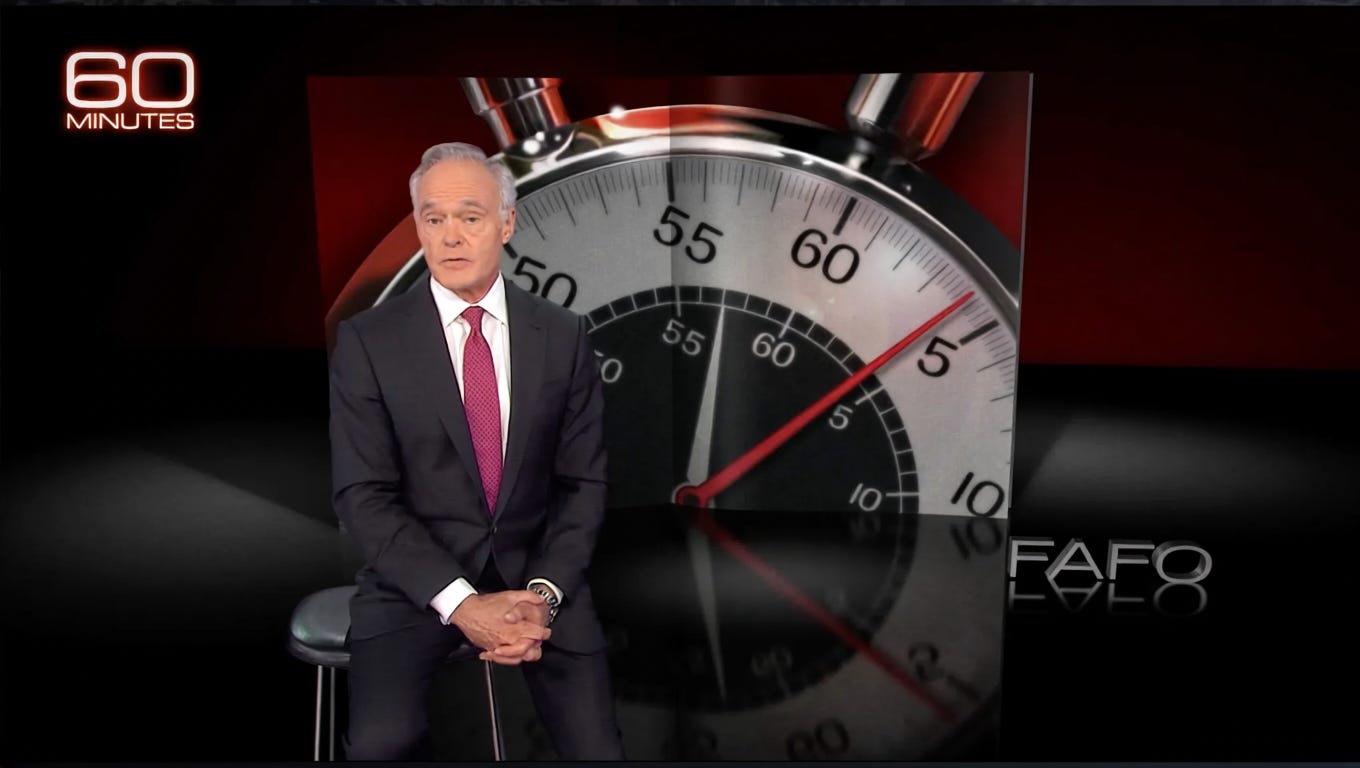
I’m Lowell Bergman; I’m from 60 Minutes. You know, you take the 60 Minutes out of that sentence, nobody returns your phone call. - The Insider, 1999
When I heard that soon-to-be erstwhile 60 Minutes correspondent Scott Pelley was chumming to be free at last after an ill-advised rant directed at his incoming boss, new 60 Minutes executive producer Nick Bilton, I had to laugh. Pelley, who, according to multiple witnesses, hotly informed Bilton in their first meeting that he was “murdering” 60 Minutes, was merely tapping into what most TV journalists actually do best—performative art.
Pelley is about my age and has been around the block a time or two. He surely knows all about the odds of getting a second chance to make a first impression. I suspect that what actually happened is that Pelley saw the writing on the wall at CBS and decided that he wanted no part of being held accountable for the first time in his career. Then, in looking for a way out of his contract that shaded CBS and painted himself a hero, Pelley went after his new boss in a manner that he knew would go public over “journalistic principle,” creating a halo of sanctimony and bravery around his exit.
CBS, however, had the last word, firing Pelley without cause. No golden parachute for him. And a few months from now, with all of the moving pieces in journalism, it will likely be Scott who?
Yo, Leslie Stahl, you listening, girl?
The venerable 60 Minutes might have been great at one time, but to the degree that it was perhaps once so, it’s been a while. In my view, 60 Minutes has been capable over its run of being fabulous but often driven more by sensationalism than exceptional journalism. And lately, the wins for 60 Minutes have been fewer and farther between.
Any news program purporting to be a bastion of journalistic integrity while employing Anderson Cooper as a correspondent needs some help. Right now that’s Bari Weiss. We’ll just have to see what she can do with the mess she inherited.
Scott Pelley and his preening compadres actually have more to worry about than the likes of Bari Weiss. Along with their industry bedfellows: porn performers, musicians, and actors, AI is coming for their jobs. By the time Pelley gets around to looking in earnest for a comfortable landing spot, he might be competing with AI entities that are cheaper to employ, easier to get along with, will do anything asked of them (something that is particularly useful for news correspondents and porn stars), always have the perfect coif, and don’t need no stinking agent from CAA.
From the executive suite’s perspective, why pay for high-priced, vacuous talking heads with all of the cuddly warmth, friendliness, and predictable, even temperament of a cage full of honey badgers when AI can create any amiable version of Max Headroom imaginable (as well as a few that probably aren’t) in ultra-high resolution for the shared cost of a few data centers?
Surely not for trust.
This is already a thing. Consider Sports Illustrated, once the undisputed leader in magazine sports journalism, with content written by luminaries such as William Faulkner, Robert Frost, Carl Sandburg, John Steinbeck, Ernest Hemingway, John F. Kennedy, John Updike, James Michener, Jack Kerouac, Jimmy Breslin and Frank Deford. SI recently FAFO’d about alienating readers after ditching the decades of romance with a bevy of phenomenal writers and flirting, instead, with younger, cuter AI. It did not end well.
While replacing staff writers with AI, SI went further and took steps to obscure the fact that content was being generated by AI. Staff at SI created fake byline profiles with AI-generated headshots and, in at least one instance, even created fake Facebook, X, and TikTok accounts to create the illusion of a real columnist.
The best account of this fiasco that I’ve read is Ted Gioia’s How to Destroy a Literary Reputation in One Move on The Honest Broker. I recommend it for your edification.
With this expert-level stupidity, Sports Illustrated managed to squander seven decades of the kind of credibility that comes with being the gold standard in just a few months. After two rounds of subsequent layoffs and firings, Sports Illustrated now exists only as an online vessel for marketing and sports gambling. Their downfall is stunning.
This does not mean, however, that anyone learned a lesson from the SI debacle and that AI dumbassery isn’t a bona fide trend. Don’t make the mistake of assuming that there’s reason at the other end of any of this. That would make you Don Lemon.
There’s more. Like Sports Illustrated, Spotify is under fire for promoting fake artists with AI-generated music, some of which reaches millions of streams. When called out, they profess to be shocked, shocked, that there is rampant use of AI on a platform that isn’t content merely to squeeze artists to the tune of fractions of a cent on the dollar for streaming rights when they can potentially realize zero cents on the dollar by cutting out artists entirely.
So there you go. Scott Pelley, behold your destiny, pal. Maybe Bari Weiss, who at least values human journalists, will toss some change in your cup if she sees you holding up a “Will Rage for Food” sign on the corner of W 52nd and 11th. Nick Bilton? Not so much.
It’s a brave new world out there, and on the general topic of AI, I am, for the moment, agnostic. I think that AI, properly implemented, has the potential to be exceptionally useful. In some fields, like computational physics, mathematics, and medicine, even paradigm shifting. But I see little evidence of any of that so far. Time will tell. Right now, what I see from AI is prodigious slop and massive intent to deceive. None of that invokes much of a warm and fuzzy feeling or a tingle down low.
Along that line, I know that AI data centers are the new fashionable thing to hate right now, uniting many who agree on virtually nothing else. There exists even in my own small town here in the Intermountain West a populist uprising against a proposed data center, much of which makes little sense.
Data centers are not intrinsically bad and pose no more of a potential nuisance than any other similarly sized industrial project. As always, you just have to read the fine print. Most of the objections I’ve heard are crazy talk. But some are not. It’s a mixed bag.
But to the degree that dislike and distrust of data centers intertwine with dislike and distrust of AI, I’m down with that. I think that AI has been rolled out with atrocious development, poor and dishonest implementation, few guardrails, and virtually no comprehensive thought as to either intended or unintended consequences. I think that the current motives for embracing AI are very clear and have little to do with making the world a better place.
Students use AI to cheat; judges use it because they are too jaded to actually sit down and write opinions; doctors and lawyers use it to free up time to bill even more clients; writers use it because they have no talent (ditto musicians); and executives use it to eliminate labor costs.
What I’m not seeing, despite the hoopla, is evidence for a fifth fundamental interaction coming out of CERN via AI.
Note to readers. Next week is my 70th birthday, and as is our custom, we plan on being on the road to celebrate in some fun place, most likely Devil’s Tower. This summer the annual Groms Across America tour will also include the Great Lakes, Cedar Point, Washington, DC (where our congressional delegation has hooked us up!), Kentucky, Great American Ball Park for the 4th of July, and St. Louis.

I’ll try to get another column out before we leave, but apart from a few short pieces, I’ll be on vacation until July 10. We’d like to thank all paying subscribers for making this happen as Substack funds our road trips. Cheers.
Associated Press and Idaho Press Club-winning columnist Martin Hackworth of Pocatello is a physicist, writer, climber, skier, motorcyclist, musician, and retired Idaho State University faculty member who now spends his time raising four kids. Follow him on X at @MartinHackworth, on Facebook at facebook.com/martin.hackworth, and on Substack at martinhackworthsubstack.com.
I remember when Dan Rather came out with what purported to be papers about George W. Bush‘s pathetic performance in the air National Guard. And when you looked at the type written script, it was clearly not written by the wonky typewriters that the armed forces usually employed, which would have terrible cerning and no automatic adjustment of printed elements (like an elevated numeral for a footnote.) The papers were such obvious fakes that they deservedly destroyed Rather’s over hyped reputation. And who can forget Pierre Salinger’s public self-immolation over his “discovery” of a faked photo showing a missile taking down TWA 800?
Besides the problem of AI being used to replace people and do their work for them badly (if they are too lazy or rushed to use their own human brains to check it really carefully), I know that years ago the Library of Congress was supposed to be in the business of having a copy of every book and other documents that they could get their hands on, for purposes of a comprehensive national archive; is that even a possible goal for them anymore? And there is the Wayback Machine website, which had a problem with their archives recently, I think I read, someone wanting to censor them. Some millennia ago, the loss of the Library of Alexandria was mourned, and I have read about the secret hidden library (not so secret now) of Timbuktu. So, the thing I wonder when I read or view another obviously AI produced synthesis of information, is this: are there preservation efforts going on to save in hard copy (book, manuscript, sheepskin...) the knowledge of the 19th century in particular but on up to the present day, that someone might actually need to go back to someday - do most of the scientific journals even publish paper copies anymore? And as libraries clear out their old stacks to update themselves, are those old journals and dissertations and indexing volumes going back into the 1800s or even 1700s (as a chemistry student, I spent hours in CAS - chem abstracts services - hardcopy volumes) mouldering somewhere beyond recovery or are there actual carefully curated copies of them somewhere (like the Library of Congress archives)? This bothers me for two main reasons: Digital isn't permanent like paper is permanent, if for instance a data center burns, what is lost permanently, and also, just storing electronically is subject to degrading and replication errors over time. And AI can only synthesize from what it grabs online via its algorithms, but the more AI slop there is, the more AI will pull from AI, and I wonder at what point you will no longer be able to have any confidence in what you read or see, because you are so far beyond the source material, especially as the "source" material itself is suspect in many cases now. Then someone who really needs to figure something out will have to painfully track back to and locate the actual source material. That probably is wandering way off into other AI and data center issues.