
Train Dreams
An understated, poignant meditation on a man's journey through life.

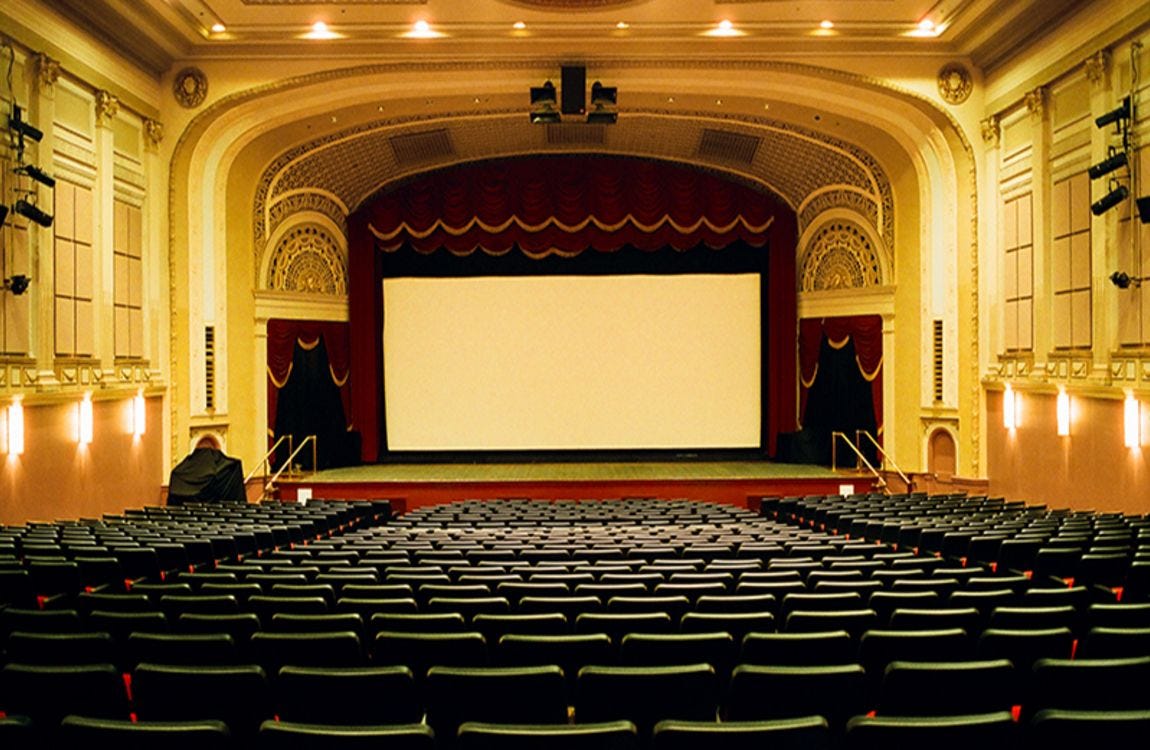
From the mid-1970s until the early 1990s, I lived in Lexington, Kentucky. One of the most memorable features of Lexington for me was the Kentucky Theatre, an old theater palace on Main Street that originally opened in 1922. It was a grand old venue that featured ornate Italian Renaissance architecture: cartouches, rosettes, and cherubs with huge velvet drapes that parted just before the projector fired up for a film. The Kentucky also sported a 4,000-bulb marquee, 1,276 seats, and a $25,000 Wurlitzer organ. I never heard the Wurlitzer, but the rest was a routine part of the experience.
The Kentucky Theatre, during my time, was best known for dollar (or less) admission tickets and wonderful, eclectic movie festivals. I once saw, over the course of a week, every film (to that date) of Werner Herzog along with Burden of Dreams, a documentary about the making of one of Herzog’s most ambitious films, Fitzcarraldo.
I don’t know if I missed a Saturday midnight showing of the Rocky Horror Picture Show during my entire sophomore year at the University of Kentucky. The first time I saw Casablanca was at the Kentucky with a very pretty date. Talk about movie magic!
Though the Kentucky did occasionally run a contemporary Hollywood film, it was mostly a cinematic refuge for people, like me, who preferred independent and foreign films that were scarce elsewhere. I saw thousands of films there from 1974 until it was closed by a fire in 1987. Those were some good times.
I rarely go out to see movies anymore, and then only to take the Groms to something they are excited about. The last time was some forgettable Marvel movie, which cost almost a hundred bucks for the five of us. At home, we have several state-of-the-art large TV screens hooked up to a bodacious sound system far better than the one at the local cineplex. Most theatrical releases take just a few weeks to become available via streaming these days anyway. Soda is cheap, and popcorn doesn’t cost $20 a tub at Chez Grom. It’s an easy call.
But man, I do miss watching 20-foot-tall versions of Louis and Rick walk off into the fog as they discuss joining the Free French in Brazzaville. I don’t know if “Louis, I think this is the beginning of a beautiful friendship” works quite as well in a living room. No velvet curtain either.
Nonetheless, times have changed. Aside from the prohibitive cost and poor experience at corporate cineplexes, there just aren’t that many movies worth going out for anymore. I see, perhaps one or two films every year or so, that I think are worth watching more than once. And I generally see these at home.
The modern profitable cinematic archetype—characterized by car crashes, gratuitous sex and violence and blowing shit up for eye candy rather than to advance a plot—just doesn’t do it for me. I like dialogue that appears to have been written for adults and visuals that are stunning without going boom. And then there’s the foisting of Hollywood’s weird, single-zip-code values on the rest of America via the silver screen, which makes me want to bring along a railroad spike to the movies to hammer through my knee.
The few movies that my kids are able to convince me to take them to come with another problem. Even if the movie itself is appropriate, about half of the 20 or so minutes of "coming attractions" are not entirely suitable. It all adds up to just staying home. There’s no way I’m voluntarily paying for such a mess. I suspect, given the declining profits of many movie chains, that I’m far from alone in that sentiment.
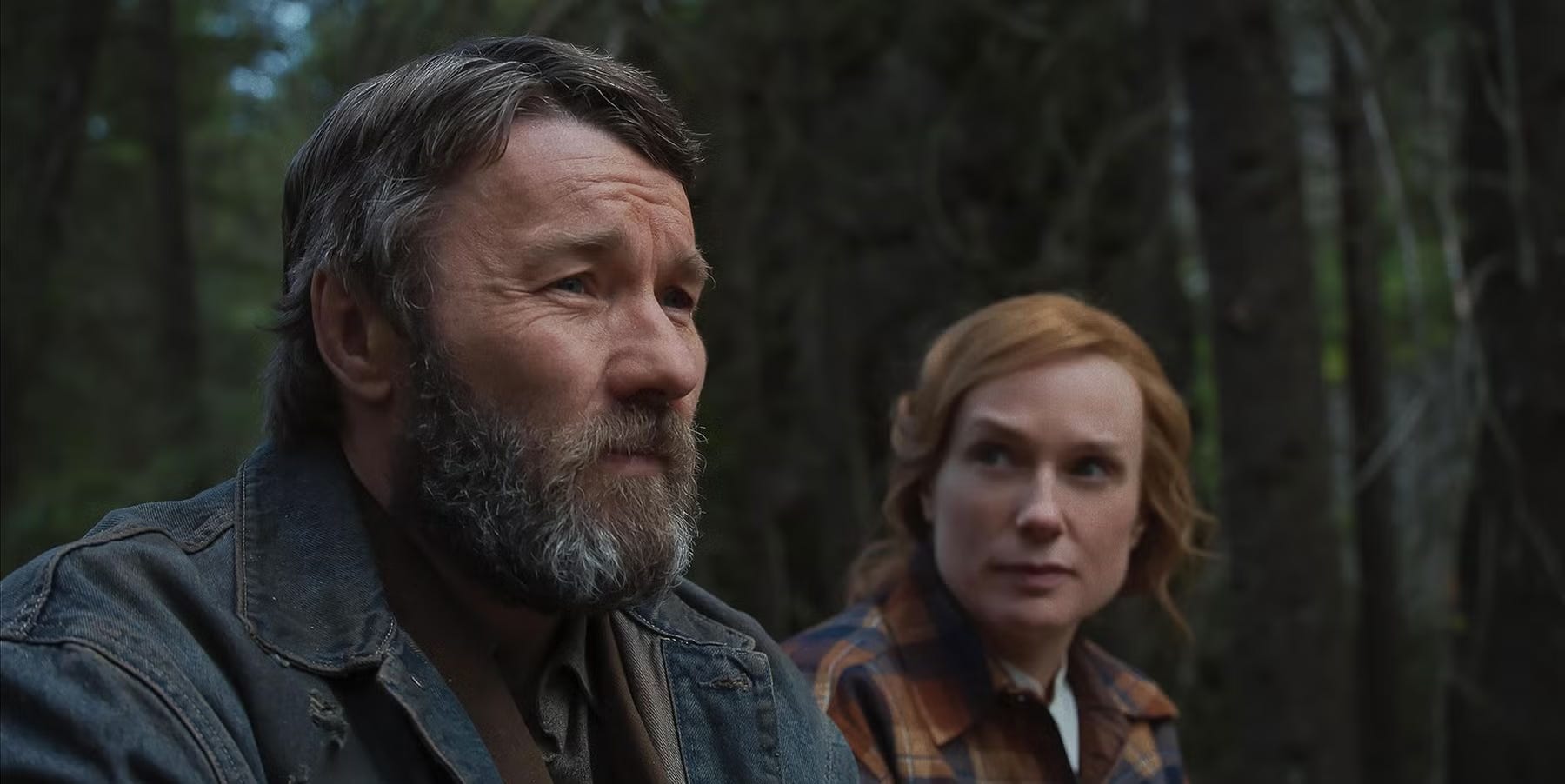
But every once in a rare while, a cinematic gem still comes along that’s not a waste of time and talent in the pursuit of return on investment. Train Dreams is such a film. Featuring a half-dozen wonderful performances, especially Joel Edgerton and Kerry Condon, and a brilliant screenplay by Clint Bentley and Greg Kwedar, Train Dreams, directed by Bentley from a novella by Denis Johnson, is a tremendous film that you should waste no time tracking down to view.
Train Dreams is a brilliant, understated meditation on a quiet man’s journey through life. It's a portrait of Robert Grainier (portrayed by Edgerton), a logger and railroad worker who leads a life of profundity, beauty, and great loss in the woods of North Idaho, beginning in the early years of the 20th century until his death in 1968.
The cinematography, by Adolpho Veloso, pays homage to the visual brilliance of filmmaker Terence Malick. The influence of Badlands and Days of Heaven is obvious in every frame—and I mean that in the best way.
The type of understated storytelling in these films is accomplished with light and the juxtaposition of stillness and motion. It’s the quiet of a dark forest before felling a tree; it’s the silent specter of a terrible deed that haunts the protagonist in his moments alone; it’s a moving train car contrasted against much faster automobiles on a distant bridge; it’s a gentle transition from one life to another, torn away in an instant by the Great Fire of 1910 (though a couple of decades out of sync with actual events); it’s a man asking life’s basic questions, getting few answers.
Given the visual richness of the film and depth of storytelling, it’s difficult to rank one scene in Train Dreams as any better than another. But nearly every scene with Kerry Condon and Edgerton pops right off the screen. Condon, whose talents are currently being wasted in the big-budget film F1, shines here.
Audiences may recognize Condon as Michael Ehrmantraut's daughter-in-law from the television series Better Call Saul. In that role, Condon was a part of what I reckon as one of the most brilliant episodes of any show in the 90-year history of broadcast TV. Rock group 38 Special’s Hold On Loosely hasn’t been the same for me since Five-O. You might want to be sitting down if you watch the following clip with Condon and Jonathan Banks.
Towards the end of Train Dreams, an old and worn-down Grainier, who knows that his life is slipping away, comes out of the woods to the streets of Spokane, Washington, where he encounters a black and white TV in a department store window displaying John Glenn’s flight into space—something that has to be explained to him by a fellow spectator. I remember watching the first moon landing just a few years later on a TV set in a department store window in my small town in the foothills of Appalachia with some old timers.
This scene vividly brought me back to that moment. How I wish that I knew then what I know now.
The last two minutes of Train Dreams, where Grainier finally comes to understand his connection with life in a visually stunning, poetic and poignant epiphany, is one of the best denouements in all of the films I've seen. It’s a perfect cinematic moment. Having seen more than a fair share of films, I can assure you that this is rare.
The only thing that mars Train Dreams is something that’s not actually in it. I read on a movie industry site how the filmmakers were insistent that no actual trees were felled in the making of the film. Any wood that was cut was a prop. Hollywood can’t help itself. I live in a house mostly made mostly of wood. Does that mean that I’d have been kept out of the premiere at Sundance?
I’m not much of a film critic. I’m more of an if-you-can’t-say-anything-nice-don’t-say-anything-at-all kind of guy. Every movie ever made, no matter how terrible I thought it might be, had a budget, a script, a director, actors, and a small army of craftspeople who breathed life into something as ephemeral as an idea. That’s not a small thing. I respect, at least, the effort.
But some films are clearly better than others—even accounting for taste. Train Dreams is one of those films.
Associated Press and Idaho Press Club-winning columnist Martin Hackworth of Pocatello is a physicist, writer, climber, skier, motorcyclist, musician, and retired Idaho State University faculty member who now spends his time raising four kids. Follow him on X at @MartinHackworth, on Facebook at facebook.com/martin.hackworth, and on Substack at martinhackworthsubstack.com.
Thank you, Martin, for the recommendation! I seldom go to a movie theatre to see a film. I have learned that the real start time of the movie is about 30 minutes after the posted start time - 30 minutes of bombastic advertising and previews of things I never want to see.
I have to admit that I've been passing over this one because I just assumed, given the subject matter and marketing, that its rating in Pascals had to be very high. Pascals not as in the SI unit of stress named after Blaise, but Pascals as in the Wokeness unit named after Pedro.
I truly wish someone would start reviewing films, novels, anything in the arts etc and incorporating this parameter. Whether you agree with the politics or not, a high value of PPa means you can figure out key plot points in advance. E.g, my wife and I were watching Task when I suddenly told her I knew who the traitor was. She said "Who?" and I replied "Which white guy has not behaved badly -- yet?". And... (mild spoiler)... Bingo! I gave up on Last of Us cold turkey after the notorious "wine pairing" scene, and don't get me started on Broadchurch, yikes.
Now the missus and I both like Olivia Colman, but I'm getting uh-oh vibes from Night Manager. If I knew its rating it would save me the trouble. Anyone care to enlighten me, please?